
Nila
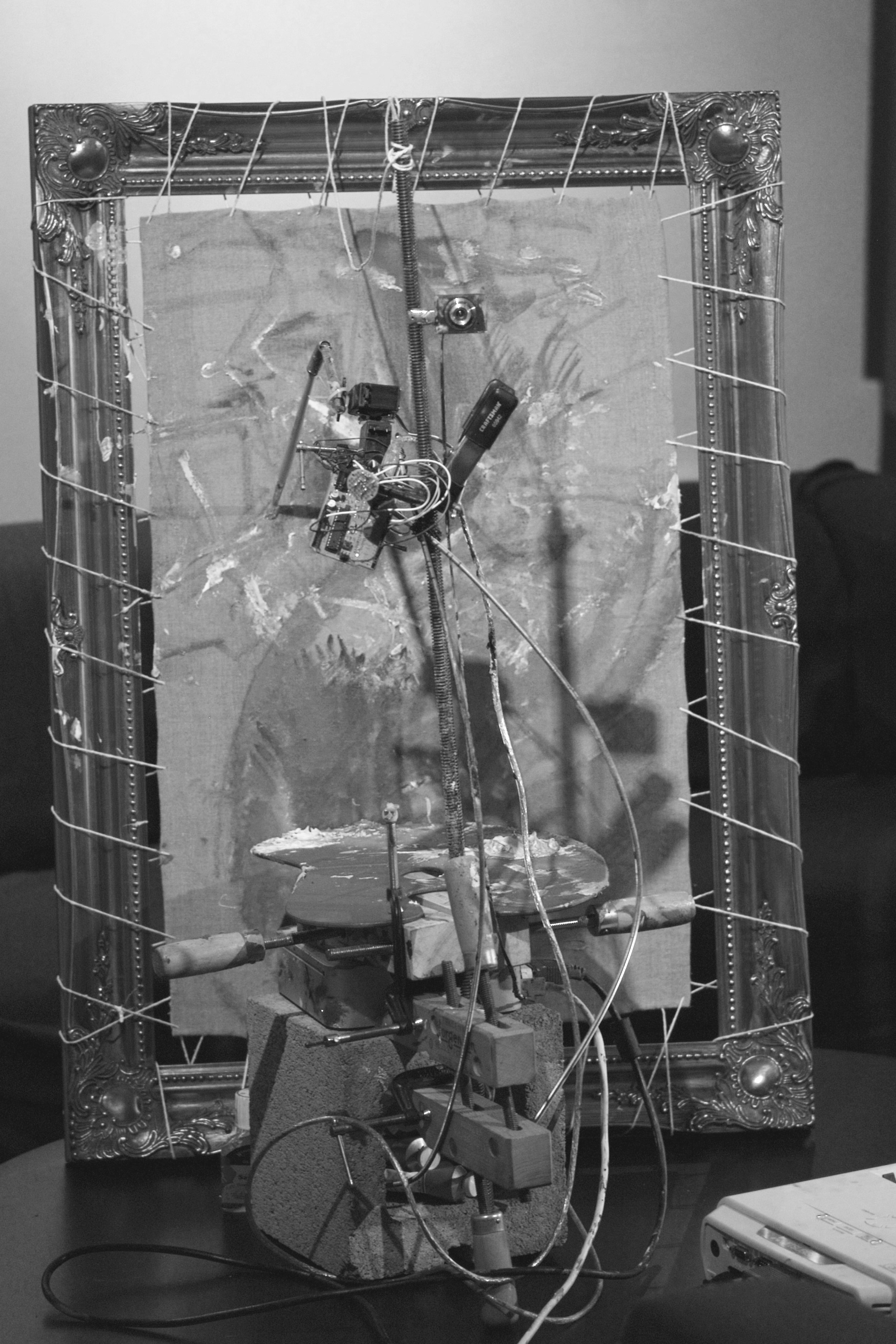
Nila paints in black and white, and her brush moves based on the movement of light in the room.
/art posts tagged with #nila


Nila is my first oil painter. I began conceptualizing her in the Summer of 2008. My professors at Berkeley had scolded my prior machines' careless use of media (bottle colors, cheap acrylics, pre-primed canvases, paint-ruined brushes).
I returned to Nepal, where I had received thangka painting lessons the year prior. They have a way of stretching a canvas like a hide and priming it almost into paper, which I asked they teach me. Every step of their process is so slow, deliberate, and devotional. My lamas were two brothers, one who would always smile at my work and one who would always frown. They'd say the same thing, "ramro." This is Nepali for both "beautiful" and "good," but I could always tell which one they meant.
Nila paints in a circle, both for mechanical simplicity and in the tradition of the mandalas. Her brush tracks the brightest point of light in the room, with lighter tones in the daytime and darker tones at night. My thesis committee spoke often of light in painting, so Nila's code came from a want to explore that idea in an abstract (or perhaps very literal) way.
A quote from Donielle Kaufman:
Ultimately, our empathy towards Nila (ascribing human-like traits to her actions and form) is what makes her teaching so successful. Without anthropomorphizing her, viewers would have minimal desire to explore the perception of a robot. Yet, because we can think of Nila in terms of our own experience, I believe we are more willing to expand our construction of the world and accept hers. Nila reveals, to her viewers, the very structure of her robotic language. Communicating with Nila, in turn, encourages viewers to examine their relationship to technology in a rapid, wiki-world. Greig explains, "I try to show people what it's like to try and befriend every piece of technology around. Nila tries to show people what it's like to sit perfectly still and track the motion of light around the room." In a fast changing world, the artist's most important role may be to examine these connections in order to help us relate to a new reality. Nila, though she has a life of her own, still expresses Greig's own concerns and visions of reality. A tension exists between technology and art, between our day-to-day experience and Nila's brushwork, making Nila's project a logical venue to navigate our own relationship to technology.
-Exhibitionism show catalogue
Courtauld Institute, January 23, 2010
A quote from Dena Beard:
Laura Britt Greig's robots often exhibit surprising behavior while performing routine tasks. Constructed as bodies with technological organs rather than tissue, Greig's works ask that we acknowledge their presence in the same way that we might confront a stranger. Particularly since her robots are media-makers, actively producing images with the same subtle variations as those produced by human arms, the onus is on us to determine their role in our rapidly growing technocracy.
-What We Can Live With press release
Berkeley Art Museum, May 15, 2009